Why People Don't Trust Testimonials Anymore (and How to Make Yours Believable)
Visitors don’t distrust customers they distrust proof they can’t check. Why testimonials lose credibility, the 7 signals that make one believable, and an 8-point checklist for your website.
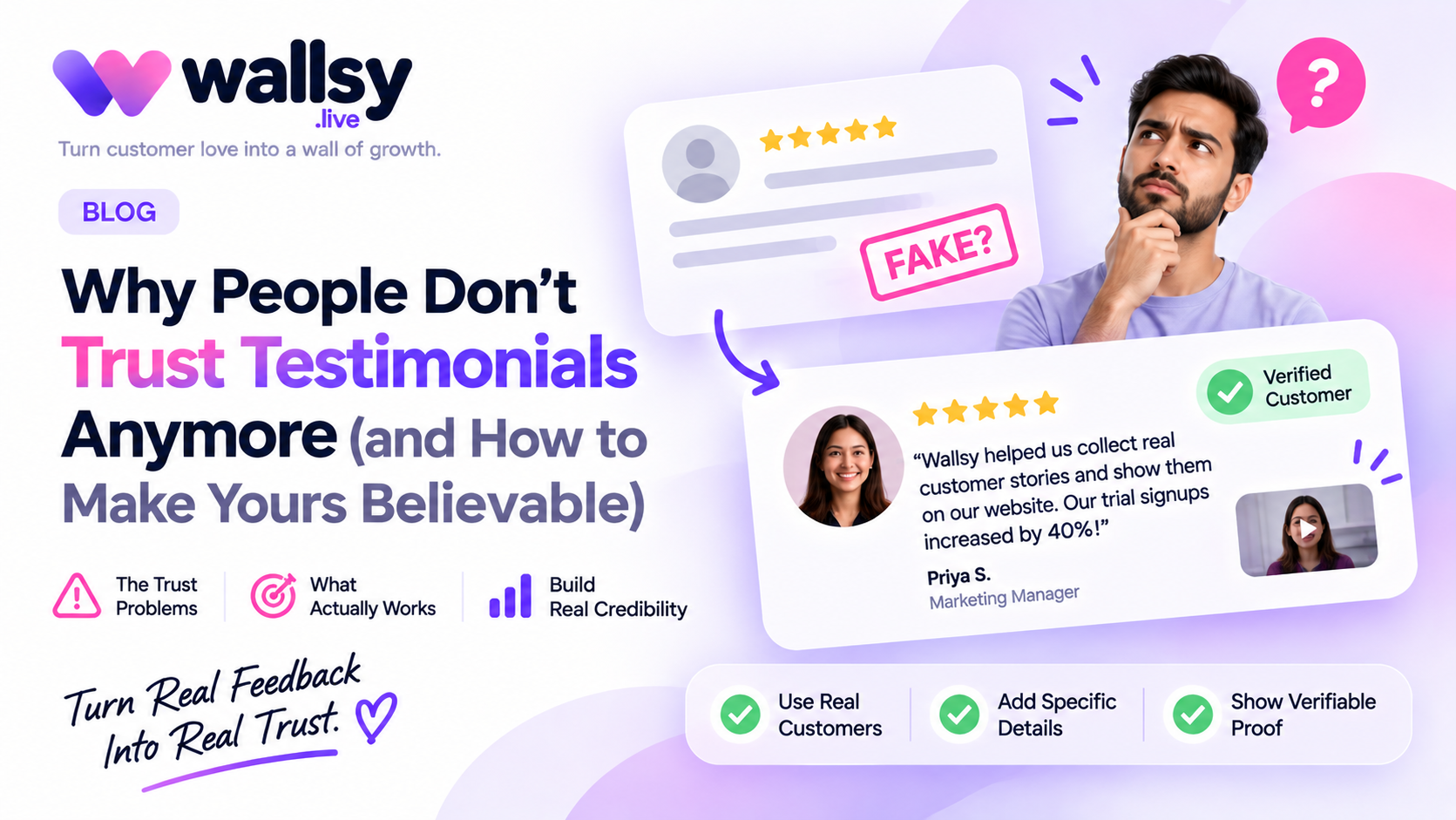
Most people have learned to skim past testimonials. "Amazing service! ⭐⭐⭐⭐⭐ — J." could have been written by anyone, and these days it often feels like it was written by no one at all. When AI can produce a page of glowing reviews in seconds, a wall of praise proves very little on its own.
The good news: visitors haven't stopped trusting customers. They've stopped trusting proof they can't check. This guide covers why testimonials lose credibility, the seven signals that make one believable again, and a checklist you can run over your own website today.
Why people stopped believing testimonials
A testimonial has one job: to convince a stranger that someone like them got a good result. It fails when the reader can't tell whether it's real. Five patterns cause most of that doubt:
- Anyone can write them. Visitors know that a business chooses, and sometimes writes, the quotes on its own website. Since AI tools became common, perfectly polished praise reads as more suspicious, not less.
- They're anonymous. "Sarah M." or "— a happy customer" gives the reader nothing to hold on to.
- They're vague. "Great product, highly recommend" could describe a dentist, a SaaS tool or a bakery. Without details, it sounds like filler.
- Everything is five stars. A spotless record looks curated. In the Spiegel Research Center's study of online reviews, purchase likelihood peaked for ratings between 4.0 and 4.7 stars and dropped as ratings got close to a perfect 5.0.
- There's nothing to click. No photo, no company, no link to where it was said. The reader has to take your word for it — and your word is exactly what they're testing.
None of this means testimonials don't work. It means the ones that work now look different.
7 signals that make a testimonial believable
You don't need every signal on every testimonial. But each one you add makes the quote harder to dismiss.
1. A real name and role
A full name, or at least a first name with a role or business type, tells the reader who is speaking. "Priya, owner of a two-person bakery" is far more convincing than "P.", because the reader can judge whether Priya is someone like them.
2. A face
A photo turns a quote into a person. It doesn't need to be professional — a normal profile photo the customer chose is better than a stock image, which visitors spot quickly.
3. A company you can actually visit
When a testimonial mentions a company, let readers click through to its website. It's the simplest form of verification there is: the business exists, the person works there, and anyone can check. It also gives your customer something in return — a link to their site.
4. Specific details
Specific testimonials are believable because they're hard to invent. Compare:
| Vague | Specific |
|---|---|
| "Great service, highly recommend!" | "We had our first client testimonial live on the site the same afternoon we signed up." |
| "Easy to use." | "My customers don't need an account — they tap the link, pick the stars and write two lines." |
| "Best decision we made." | "We used to copy nice emails into our website by hand. Now new ones arrive in one inbox and I approve them." |
These examples are illustrative — we wrote them to show the difference. Always publish your real customers' own words.
You don't get specific testimonials by rewriting vague ones. You get them by asking better questions. See our list of testimonial questions.
5. A believable spread of ratings
If you show star ratings, a mix of 4s and 5s is more convincing than a perfect row of 5s. That's what the Spiegel research above suggests, and it matches common sense: real customers rarely agree perfectly. You don't need to go looking for criticism, but don't treat a 4-star testimonial as something to hide.
6. A link to where it was said
If a customer praised you publicly — for example in a post on X — showing that post with a link back to the original is strong proof. Anyone can open it and see it was written by that person, in public, on their own account.
7. The customer's own words
Light edits for typos are fine. Rewriting for polish is not: it removes the small quirks that make a testimonial sound human, and if it changes the meaning, it misrepresents your customer. A slightly messy sentence that's clearly genuine beats a perfect one that sounds like marketing copy.
Where AI fits — and where it doesn't
AI is useful around testimonials: it can help you draft the email that asks for one, or suggest better questions for your form. It should never write the testimonial itself.
This isn't only about trust. In the US, the FTC's rule on consumer reviews and testimonials bans fake testimonials, and the FTC has said this includes AI-generated ones that don't reflect a real customer's experience. Violations can bring civil penalties. We cover the details in our guide to the FTC fake review rule.
A simple rule: AI can help you ask. Only your customer can answer.
Your believability checklist
Go through the testimonials on your homepage and pricing page and check each one:
- Is there a name — and a role, business type or company?
- Is there a face — a real photo, not a stock image?
- Can a reader click through to the customer's company or the original post?
- Does it mention one specific detail — a result, a moment, a before-and-after?
- Does it sound like a person, not like your own marketing copy?
- Did the customer give permission to publish it with their name — and do you have a record of that?
- Are the star ratings believable, rather than a perfect row of 5s?
- Is it recent enough to still be true about your business today?
If a testimonial fails most of these, it's not working for you. Ask that customer, or a new one, for a fresh testimonial with a specific question.
How Wallsy makes testimonials easy to believe
Wallsy is built around testimonials from real customers, with the signals above built into every card:
- Customers write their own. They leave a star rating and a few sentences through your collection page — no account needed. Wallsy never writes or generates testimonials.
- Name, role, company and photo. Your collection form can ask for a job title, company and photo, and they appear on the testimonial card.
- A clickable company link. Turn on the "Company website" field in your form, and the company name on the card links to the customer's website.
- Posts from X link back to the original. Import public posts from X, and each card links to the post it came from.
- Permission is recorded. Customers tick a permission box before submitting, and the time they agreed is stored with the testimonial.
- You approve everything first. Nothing appears on your Wall of Love or website widget until you publish it.
FAQ
Do people still trust testimonials?
Yes — but they trust the ones they can check. A testimonial with a name, a photo, a company link and a specific detail is still one of the most convincing things you can put on a page. Anonymous, vague praise is what people skip.
How do I make my testimonials more credible?
Add who said it (name, role, company), a photo, and one specific detail about the result. Link to the customer's company or the original post where you can, and keep their own words rather than polishing them.
Are AI-generated testimonials legal?
Not as testimonials. In the US, the FTC's Consumer Review Rule bans fake testimonials, including AI-generated ones that don't reflect a real customer's experience. Using AI to help write your request email is fine; using it to write the testimonial is not.
Should I show testimonials with fewer than five stars?
Yes, if they're positive overall and specific. A mix of 4- and 5-star ratings looks more real than a perfect score, and research on online reviews found purchase likelihood was highest for ratings between 4.0 and 4.7.
Is it okay to edit a customer's testimonial?
Fixing typos is fine. Changing the meaning, or making it sound more enthusiastic than the customer was, is not. If you want different wording, ask the customer to approve it.
Collect testimonials people believe
Wallsy gives you one link to collect testimonials from real customers — with their name, role, company, photo and a link to their website — and lets you approve each one before it goes live on your Wall of Love and website. The Free plan includes 4 published testimonials, a collection page and the Grid widget.
Create your free Wallsy account
Related reading: 12 testimonial examples and why they work · The FTC fake review rule in 2026 · Testimonial questions to ask customers
Sources
- Spiegel Research Center, Northwestern University — How Online Reviews Influence Sales (2017)
- U.S. Federal Trade Commission — Consumer Reviews and Testimonials Rule: Questions and Answers
- U.S. Federal Trade Commission — FTC Warns 10 Companies About Possible Violations of the Agency’s New Consumer Review Rule (22 December 2025)
Thanks for reading
If this helped, pass it to someone who's been meaning to collect testimonials. And when you're ready, Wallsy gives you one link to start — free for up to 4 published testimonials.