The FTC Fake Review Rule in 2026: What It Means for Your Testimonials
The FTC has started enforcing its Consumer Review Rule, with penalties up to $53,088 per violation. What it bans, the gray areas small businesses hit, and a 10-point testimonial checklist.
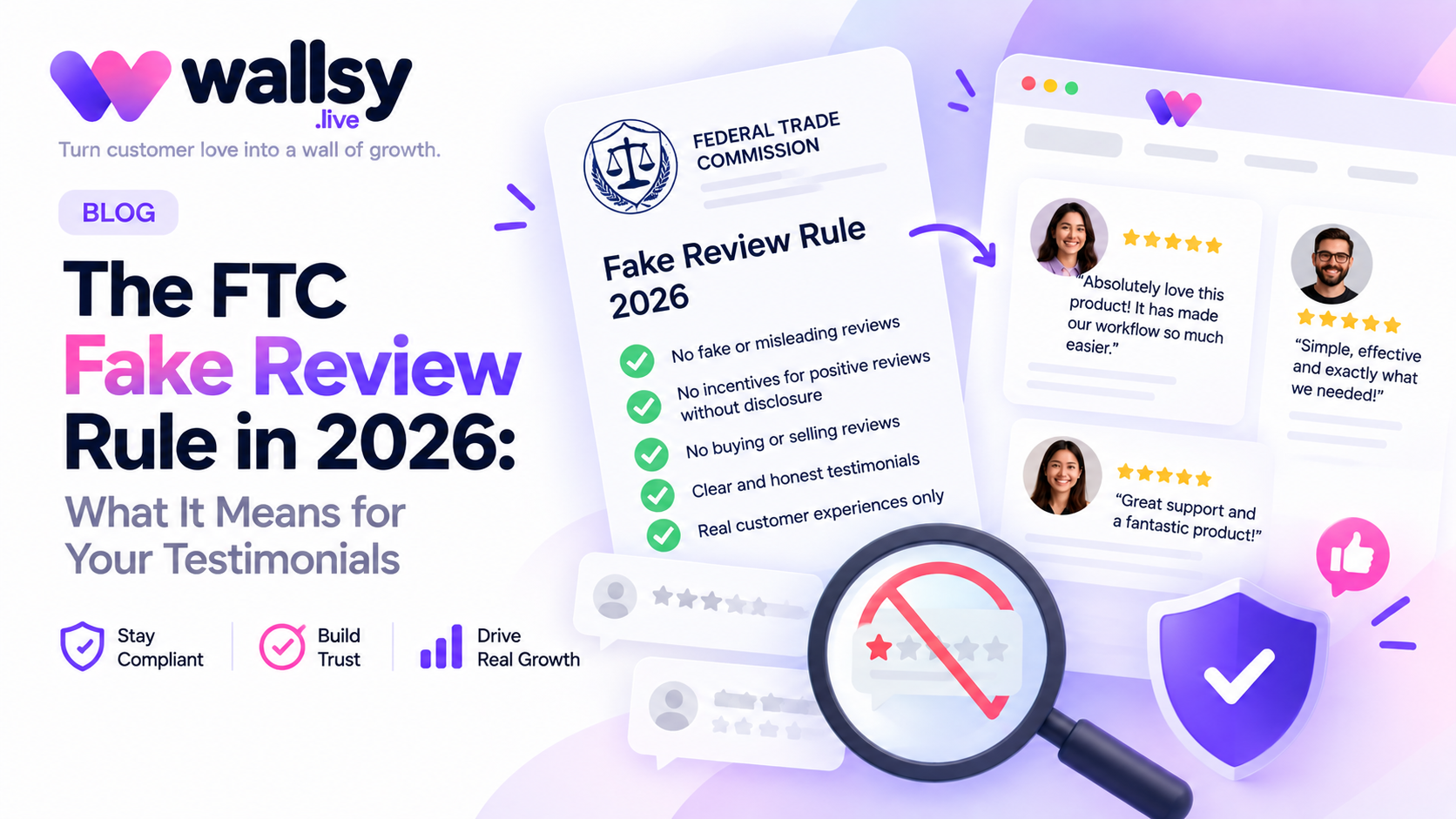
In December 2025 the US Federal Trade Commission sent warning letters to ten companies about possible violations of its Consumer Review Rule — the first public sign that the rule, in force since October 2024, is being enforced. Violations can now bring civil penalties of up to $53,088 each.
If you show customer testimonials on your website, this rule applies to you, not just to Amazon sellers and review platforms. Here's what it covers in plain English, the gray areas small businesses actually run into, and a checklist you can work through this week.
This is a practical summary, not legal advice. If you're unsure about a specific situation, talk to a lawyer or read the FTC's own guidance (linked at the end).
What is the FTC's Consumer Review Rule?
The Trade Regulation Rule on the Use of Consumer Reviews and Testimonials is a US federal rule that bans specific deceptive practices around reviews and testimonials. It was finalised in August 2024 and took effect on 21 October 2024. Unlike general advertising guidance, it lets the FTC ask courts for civil penalties — currently up to $53,088 per violation — rather than only ordering a company to stop.
It covers both reviews (on review sites and marketplaces) and testimonials (the quotes you choose to show in your own marketing). And according to the FTC, a testimonial on your own website counts as something you're publishing — not something you're merely hosting.
What happened in December 2025
On 22 December 2025, the FTC announced it had sent warning letters to ten companies about possible violations of the rule. The letters were based on consumer complaints and information from the companies; they aren't findings that the companies broke the law, but they make clear that lawsuits and penalties are on the table.
As Christopher Mufarrige, Director of the FTC's Bureau of Consumer Protection, put it: “Fake or false consumer reviews are detrimental to consumers’ ability to make accurate and informed choices about the products they are buying.”
What the rule bans
| Practice | What it means for a small business |
|---|---|
| Fake or false reviews and testimonials | No inventing testimonials, no reviews from people who never used your product, no misrepresenting someone’s experience. This includes AI-generated testimonials that don’t reflect a real customer’s experience. |
| Buying reviews with strings attached | You may offer an incentive for a review — but not one that depends on the review being positive (or negative). “Leave a review, get 10% off” is fine; “leave a 5-star review, get 10% off” is not. |
| Undisclosed insider reviews | Reviews or testimonials from owners, managers, employees, agents — or their relatives — need a clear, conspicuous disclosure of that relationship. |
| Fake “independent” review sites | You can’t present a site or page you control as an independent review source. |
| Suppressing negative reviews | No intimidation, unfounded legal threats or false accusations to get reviews removed. |
| Fake social proof numbers | No buying or selling fake followers, views or other engagement indicators. |
The gray areas small businesses actually hit
Can I choose which testimonials to show?
Yes — curating your own marketing is normal. The FTC’s guidance says businesses can organise reviews and exclude ones that are patently false or off-topic. What you can’t do is hide negative reviews specifically when you present something as a complete picture of what customers think, and the FTC warns that using unrepresentative reviews in marketing can still be deceptive under the broader FTC Act.
In practice: showing your best testimonials on a “Wall of Love” is fine, as long as each one is real and you don’t imply it’s a full, unfiltered record of every customer’s opinion.
Can I edit a testimonial?
Fixing a typo is generally fine. Changing what the customer meant — making a mild comment sound glowing, or adding a result they didn’t mention — turns it into a misrepresentation of their experience. If you want different wording, ask the customer.
Can I offer something in return?
Yes. The FTC says plainly that the rule does not prohibit incentives for reviews. The line is the sentiment: the reward can’t depend on the review being positive. Offer it to everyone who responds, whatever they say.
Can I use AI to write or “improve” testimonials?
Not to create them. A testimonial written by AI rather than a customer misrepresents someone’s experience. Using AI to suggest which questions to ask is fine; using it to write the answers is not.
What about my employees, friends and family?
Their testimonials need a clear disclosure, close to the testimonial — not hidden behind a link. If you asked all your customers for testimonials and an employee who is also a customer responded, the FTC’s guidance treats general requests differently, but disclosing is still the safe choice.
Do I need written permission to publish a testimonial?
The FTC rule itself is about deception, not consent. But showing someone’s name and words publicly without permission creates other problems — privacy and data protection laws, and simple trust. Getting clear permission, and keeping a record of when it was given, is good practice everywhere.
Your testimonial compliance checklist
- Use only real testimonials from people who actually used your product or service.
- Don’t generate testimonials with AI or write them yourself.
- Edit for typos, not meaning. If you want different wording, ask the customer.
- Offer incentives for honest feedback only — never “for a 5-star review”.
- Disclose relationships for employees, relatives and anyone you gave something to.
- Don’t present a curated selection as the full picture.
- Keep a record of permission — who agreed, and when.
- Remove a testimonial when someone asks you to.
- Don’t buy followers, views or likes to make your proof look bigger.
- Selling in the EU too? The EU’s Omnibus Directive requires businesses that show consumer reviews to say whether and how they check that reviews come from real customers.
How Wallsy helps you keep testimonials honest
Wallsy doesn’t make you compliant on its own — your practices do. But it’s built so the honest way is the easy way:
- Customers write their own testimonials. Wallsy never writes or generates them. Every one comes from a real person through your collection page — or from a public post on X that you chose to import, with a link back to the original.
- Permission is recorded. Customers tick a permission box before submitting, and the time they agreed is stored with the testimonial.
- Nothing is published automatically. Every testimonial waits in your inbox until you approve it.
- Edits are recorded. You can fix typos, and each change is logged — so you can always see what the customer originally wrote.
- Removing is instant. Unpublish a testimonial and it disappears from your Wall of Love and website widgets straight away.
FAQ
Does the FTC rule apply to small businesses?
Yes. The rule applies to businesses that use consumer reviews and testimonials in their marketing, regardless of size. The ten warning letters in December 2025 show the FTC is actively looking at compliance.
Are testimonials on my own website covered?
Yes. According to the FTC, testimonials you show on your own website are testimonials you are disseminating, so you’re responsible if they’re fake or misleading.
Can I offer a discount for a review?
Yes, as long as the discount doesn’t depend on what the review says. Offer it for any honest review, positive or negative.
What is the penalty for fake reviews?
Violations can lead to federal lawsuits and civil penalties of up to $53,088 per violation, according to the FTC’s December 2025 announcement.
Is it legal to show only my best testimonials?
Generally, choosing what to feature in your marketing is allowed, but don’t present a hand-picked selection as a complete, representative record, and never hide negative reviews through intimidation or false claims.
Collect testimonials the honest way
Wallsy gives you one link to collect testimonials from real customers, records their permission, and lets you approve each one before it goes live on your Wall of Love and website. The Free plan includes 4 published testimonials, a collection page and the Grid widget.
Create your free Wallsy account
Related reading: 12 testimonial examples and why they work · How to ask for testimonials · Testimonial request templates
Sources
- U.S. Federal Trade Commission — Consumer Reviews and Testimonials Rule: Questions and Answers
- U.S. Federal Trade Commission — FTC Warns 10 Companies About Possible Violations of the Agency’s New Consumer Review Rule (22 December 2025)
- U.S. Federal Trade Commission — Final Rule: Use of Consumer Reviews and Testimonials
- EUR-Lex — Directive (EU) 2019/2161 (Omnibus Directive)
Thanks for reading
If this helped, pass it to someone who's been meaning to collect testimonials. And when you're ready, Wallsy gives you one link to start — free for up to 4 published testimonials.